Introduction
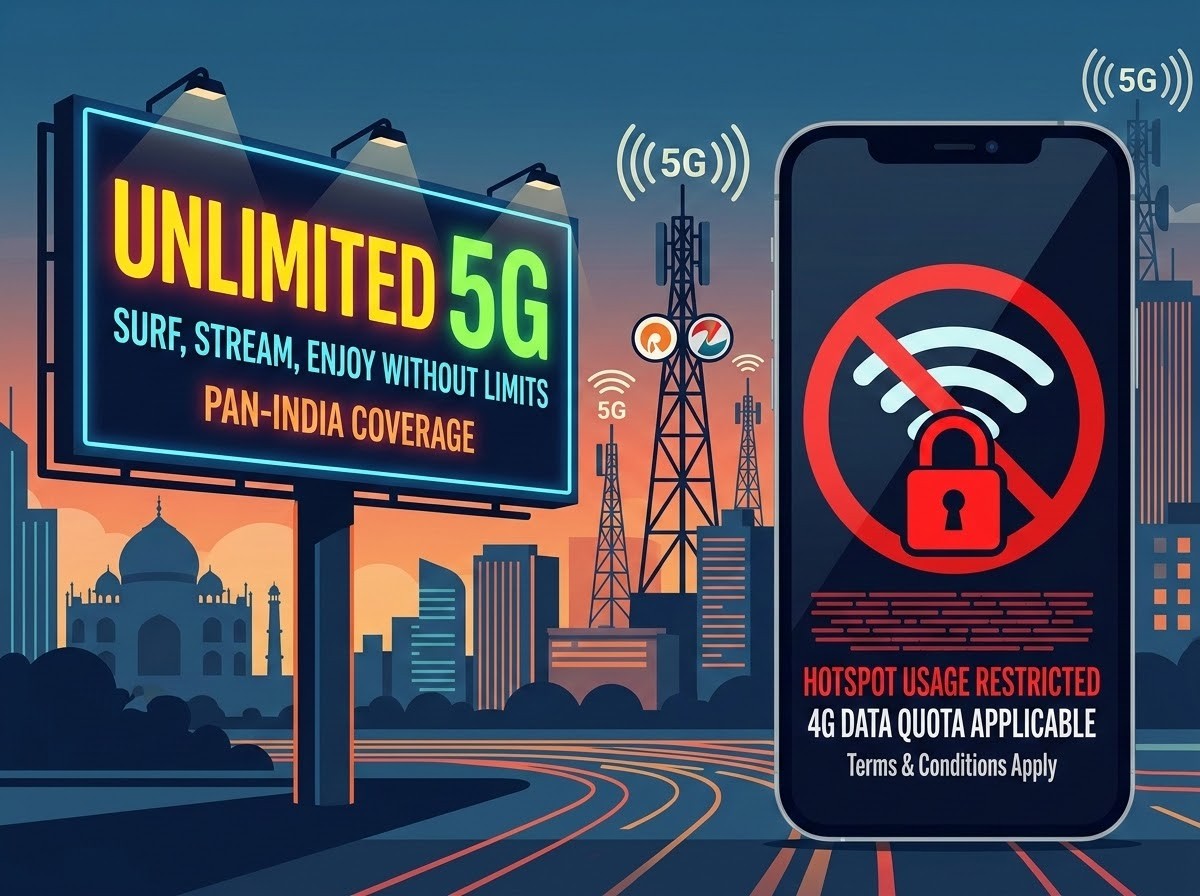
During July of 2026, it became apparent to consumers of Indian telecom that Bharti Airtel had subtly tweaked the terms and conditions of its best-selling “Unlimited 5G Data” plan. The new terms explicitly state that this particular benefit is no longer sharable via mobile hotspot feature. Within hours, copies of this changed language were widely shared on social media platforms, and Airtel confirmed that unlimited 5G benefit is applicable only for personal usage directly on the phone with a SIM card and any data used on laptops or tablets will fall under regular daily quota of 4G data (e.g., 1.5 or 2 GB/day). Moreover, the telecom confirmed 300 GB Fair Usage Policy (FUP) during each 30-day period/billing cycle after which all traffic may be considered commercial and thus subject to speed throttling or blocking of the benefit.
What at first glance seems like a mere tweaking of contractual terms in practice becomes a telling example of how consumer welfare can suffer as a result of market consolidation. This paper analyzes the change in terms and conditions, its relation to India's net neutrality policy, and, most importantly, what this says about competition law in a consolidated telecommunications market duopoly.
From Promise to Fine Print
The departure from the marketing approach adopted by Airtel is clear. On March 17, 2023, Airtel made a big announcement stating that it would “remove the capping on data usage across all existing plans,” according to its Director of Consumer Business, who said that customers would be able to “surf, stream, chat and enjoy multiple benefits at blazing speeds without having to worry about data limits.” This offer was meant for postpaid users and prepaid customers with plans starting from ₹239 and upwards, and played a significant role in boosting 5G usage in over 270 cities.
After three years, the same offer comes with conditions, such as the restriction of it only being applicable for use through a handset, 300 GB monthly cap, and the fact that once the hotspot option is turned on, consumption shifts automatically to the user’s smaller 4G daily allowance. According to reports from MediaNama, the hot spot clause had been removed from Airtel's website after it started circulating in screenshots; however, a source revealed that it might be the only remaining restriction, except for the 300 GB cap. Nevertheless, this case brings to light how loosely the term “unlimited” has been used in Indian telecommunication contracts. The competitive environment reveals the same degree of disparity: while Reliance Jio provides unlimited 5G hotspots with eligible True 5G plans and does not mention any 5G usage cap, Vodafone Idea has a cap of 300 GB per 28-day cycle without an explicit restriction on hotspots.
The Net Neutrality and Privacy Dimension
The hotspot restriction presents a doctrinal problem that the regulators in India have not yet addressed. As per the Recommendations on Net Neutrality dated 28 November 2017, the Telecom Regulatory Authority of India (TRAI) suggested that it will be mandatory to prohibit service providers from ‘any form of discrimination or interference in the treatment of content,’ including any discrimination in respect of “the sender or receiver, the network protocols, or the user equipment.” These recommendations were accepted by the Department of Telecommunications (DoT) in 2018 and included into licence conditions with non-compliance resulting in license violation. Charging differential rates for the identical bits depending on which devices are consuming them appears to be against the principle of no discrimination on the basis of user equipment. However, the provision for “reasonable traffic management practices” can serve as a good defence in this case, and the position taken by TRAI on the subject is unclear.
The enforcement process presents an additional privacy issue. Tethered traffic does not have any explicit label, and the differentiation between tethered traffic and any other traffic requires analysis of particular elements in packet headers such as Time-to-Live value, operating system fingerprinting, MTU sizes or even more aggressive Deep Packet Inspection of payload data. Right to Information requests by the Centre for Internet and Society found that Indian authorities neither mandate nor transparently disclose DPI practices, leaving subscribers with no real visibility into how their traffic is examined to police such clauses.
The Competition Law Problem
The importance of the hotspot ban is best explained by analyzing the market structure. According to TRAI subscription statistics, as of October 2025, the share of Reliance Jio in the wireless market is 41.36%, and that of Airtel is 33.59%, while Vodafone Idea has shrunk to 17.13% and BSNL to 7.9%. Almost all of India’s roughly 365 million 5G users as of July 2025 virtually all ride on the two leaders’ networks.
Airtel enjoys the sector’s highest ARPU at ₹256, and Vodafone Idea continues to lose subscribers. India is, in substance, a two-horse market.
Under Section 4 of the Competition Act, 2002, abuse of dominance by an enterprise is prohibited and includes imposing “unfair or discriminatory” terms of purchase of goods or services as well as the use of dominance in one relevant market for the purpose of protecting another. Hence, the hotspot provision can be analyzed from at least three different theoretical standpoints. Firstly, unfair condition argument: consumers buying plans that used to be unlimited lose out without being able to exit easily. Secondly, leveraging argument: both Airtel and Jio have growing fixed wireless access (FWA) home broadband operations and the restriction of hotspot use might drive the heavy data users, like students, work-from-home employees, and small businesses, towards the firm’s own FWA product, bringing up the classic issue of leveraging dominance in one market in favor of adjacent business offering. Lastly, the event is a test of India’s oligopoly regime: when two companies controlling about three-quarters of the market reduce their unlimited offerings one after another, such practice looks very much like parallel pricing of a duopoly.
Yet the legal pathways are narrower than the rhetoric. For example, in Bharti Airtel Ltd. v. Reliance Jio Infocomm Ltd., the CCI defined the relevant market as the provision of wireless telecommunication services to end users in each of India’s 22 circles, and did not find reliance on dominance despite Jio’s disruptive entry. This circle-wise and market share-centric approach makes it impossible to make a dominance finding on any individual operator, and the Indian competition law lacks “collective dominance” as a doctrine. Further, in Competition Commission of India v. Bharti Airtel Ltd., the Supreme Court of India decided that whenever a question involves a technical issue of telecommunication regulation, the issue should first be heard by TRAI, whose role is therefore prior to that of the CCI. This results in a transfer of jurisdiction, but leaves the consumer complaints stuck since TRAI has not dealt with the issue of device-based discrimination, and the proposed multi-stakeholder traffic management body in 2017 never fully materialised.
Market Effects and the Road Ahead
It is the practical financial costs that have the greatest bearing on the most price-sensitive consumers, namely students who use laptops in hostels, gig and remote workers who find themselves in places where fiber connection is not reachable, and homes where the only broadband connection is through the phone hotspot. With Vodafone Idea surviving by the mercy of the judiciary and government, and with BSNL still not offering 5G commercially, the “vote with your feet” solution proposed under competition law is largely an illusion.
Three reforms follow logically. First, TRAI needs to issue a clarification which should be binding as to whether discrimination based on device types on a particular data benefit constitutes discriminatory conduct in violation of the 2018 license conditions. Second, CCI should consider a change in tariff fine print in concentrated markets as sufficient cause to launch a market study even without Section 4 inquiry. Third, service providers need to be compelled to disclose if and how traffic is monitored to check usage terms. The term “unlimited” cannot be defined in terms dictated by a duopoly system.